

ETFs Bring Liquidity, Affordability and Access to Physical Gold Assets
By Danielle Neziol, Vice President, Online Distribution, BMO ETFs
This educational article is sponsored by BMO ETFs.
In the final quarter of 2025, BMO ETFs’ Head of ETF Strategy made a bold yet confident prediction: gold could reach US$4,500 per ounce by early 2026. At the time, it seemed optimistic for gold investors. Yet now, only a few months into the new year, that prediction has not only come to fruition but has fundamentally reshaped the way investors and market strategists are thinking about the precious metal. Spot prices briefly crested $5,500 USD per ounce late in January, before “cooling” to $4,835 USD per ounce as of writing.1 Some analysts are forecasting that prices could be pushed even higher under the right macroeconomic conditions in 2026.
This is the most bullish the gold market has looked since 2011, and investors are responding accordingly. Money is flowing steadily into gold-related assets, driven by a mix of economic anxiety, geopolitical tension, and rising skepticism around the stability of fiat currencies. The combination has created a perfect storm for gold’s resurgence—and there are several clear reasons investors are turning to it now more than ever.
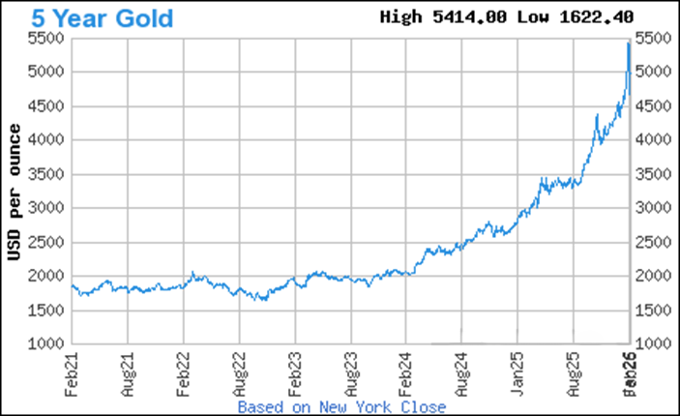
Source: Kitco.com, February 5, 2026.
Why Gold Is Back in the Spotlight
Gold’s reputation as a safe haven asset has always been one of its defining qualities. But today, that characteristic has become especially critical. With heightened geopolitical uncertainty, persistent inflationary pressures, and downward pressure on the U.S. dollar, both institutional and retail investors are seeking assets that can help safeguard wealth rather than simply grow it.
From a portfolio construction perspective, gold offers three important benefits:
1. Diversification
Gold historically shows low correlation to traditional asset classes like equities and fixed income. As markets remain volatile, this diversification has become increasingly valuable.
2. Protection Against Inflation
Gold has proven, time and again, its ability to maintain purchasing power even in inflationary environments. Unlike currencies, which are influenced by central bank policy, gold’s value is not tied to economic cycles or interest-rate decisions.
3. A Store of Value in Uncertain Times
In periods of currency debasement2 or global instability, gold has acted as a reliable store of value—one of the key reasons central banks continue to hold and, in many cases, accumulate physical reserves of bullion.
Given these dynamics, we expect investor interest in gold to remain strong throughout 2026, as both macroeconomic uncertainty and demand for defensive assets persist.
How Investors Can Access Gold Exposure
For investors looking to participate in gold’s rising price, there are several paths to consider. The most traditional method is purchasing physical gold—gold bars or bullion coins. While this is the most direct and “pure” way to gain exposure to spot prices, it comes with notable challenges, particularly for Canadian investors.
To buy physical gold in Canada, investors must work through authorized bullion dealers. As with any financial transaction involving valuable assets, due diligence is essential. Dealers vary in reputation and reliability, and investors should ensure they are working with trusted, established institutions. Beyond that, the process itself can be cumbersome. As of February 2026, a one‑ounce Canadian Maple Leaf gold coin costs roughly $6,600 CAD (remember, gold spot prices are quoted in U.S. dollars, so Canadians must factor a currency conversion into the spot price as well).3
And paying for that coin isn’t always straightforward. Most bullion dealers do not accept credit cards, which means investors often need to withdraw large sums of cash or rely on debit transactions with sufficiently high daily limits. Transporting the purchase introduces additional risk, as investors leave the dealer carrying an easily transferable, high‑value asset with little recourse if something goes wrong. For larger holdings, storage becomes another concern—secure facilities charge fees, and home storage carries theft risks.
These hurdles help explain why more investors are turning to gold ETFs as a simpler, safer and more efficient alternative.
The Role of Physical Gold ETFs
Physical Gold ETFs offer investors the convenience and liquidity of a publicly traded security while still providing exposure to physical bullion.
Take the BMO Gold Bullion ETF (ZGLD), for example. At market close on February 5, it was trading at $72.47 CAD per unit, allowing investors to gain gold exposure without committing thousands of dollars at once. And unlike a physical coin—an asset that can’t be divided—ETF units represent fractional ownership of gold, making gold exposure more accessible and affordable. Investors can buy and sell these units within their existing online brokerage accounts just as easily as they would trade stocks or other ETFs.4
However, due diligence still matters. Not all gold ETFs are created equal. Some use financial derivatives—such as futures or swaps—to mimic gold’s price movements rather than holding the metal directly. For investors seeking true physical exposure, this distinction is crucial.
ZGLD holds fully allocated physical gold bars, meaning each unit corresponds to actual gold stored in Canadian vaults under the fund’s name. When an investor buys ZGLD, they own a share of real, tangible gold—not a derivative.
Gold’s Outlook for 2026
With gold’s bull market showing few signs of slowing, the arguments for holding the metal remain compelling. It continues to serve as an effective diversification tool and a proven store of value, especially amid global uncertainty. And thanks to the ETF structure—providing liquidity, cost efficiency, and simplicity—gold exposure has become more accessible to a broader range of investors than ever before.
As markets continue to grapple with inflation, currency pressures, and geopolitical tensions, gold’s role in portfolios is poised to remain relevant throughout 2026. Whether investors choose physical bullion or a gold-backed ETF, today’s environment underscores a timeless investment truth: when certainty is scarce, gold shines brightest.
Sources:
1Canadagold.ca, February 5, 2026.
2Debasement- when the value of a currency declines, or loses its purchasing power, typically due to an increase in its supply relative to goods and services in the economy.
3 Canadagold.ca, February 5, 2026. 4BMO ETFs, February 5, 2026.
Disclaimers
This article is intended for information purposes only. The viewpoints expressed by the author represent their assessment of the markets at the time of publication. Those views are subject to change without notice at any time. The views are subject to change without notice as markets change over time. The information contained herein is not, and should not be construed as investment, tax or legal advice to any party. Particular investments and/or trading strategies should be evaluated and professional advice should be obtained with respect to any circumstance. Investments should be evaluated relative to the individual’s investment objectives and professional advice should be obtained with respect to any circumstance.
The information provided herein does not constitute a solicitation of an offer to buy, or an offer to sell securities nor should the information be relied upon as investment advice.
Past performance is no guarantee of future results.
Any statement that necessarily depends on future events may be a forward-looking statement. Forward-looking statements are not guarantees of performance. They involve risks, uncertainties and assumptions. Although such statements are based on assumptions that are believed to be reasonable, there can be no assurance that actual results will not differ materially from expectations. Investors are cautioned not to rely unduly on any forward-looking statements. In connection with any forward-looking statements, investors should carefully consider the areas of risk described in the most recent simplified prospectus.
Commissions, management fees and expenses all may be associated with investments in exchange-traded funds. Please read the ETF Facts or prospectus of the BMO ETFs before investing. Exchange-traded funds are not guaranteed, their values change frequently and past performance may not be repeated.
For a summary of the risks of an investment in the BMO ETFs, please see the specific risks set out in the prospectus. BMO ETFs trade like stocks, fluctuate in market value and may trade at a discount to their net asset value, which may increase the risk of loss. Distributions are not guaranteed and are subject to change and/or elimination.
BMO ETFs are managed by BMO Asset Management Inc., an investment fund manager, a portfolio manager, and a separate legal entity from Bank of Montreal.
BMO Global Asset Management is a brand name under which BMO Asset Management Inc. and BMO Investments Inc. operate.
Comments
Login to post a comment.