

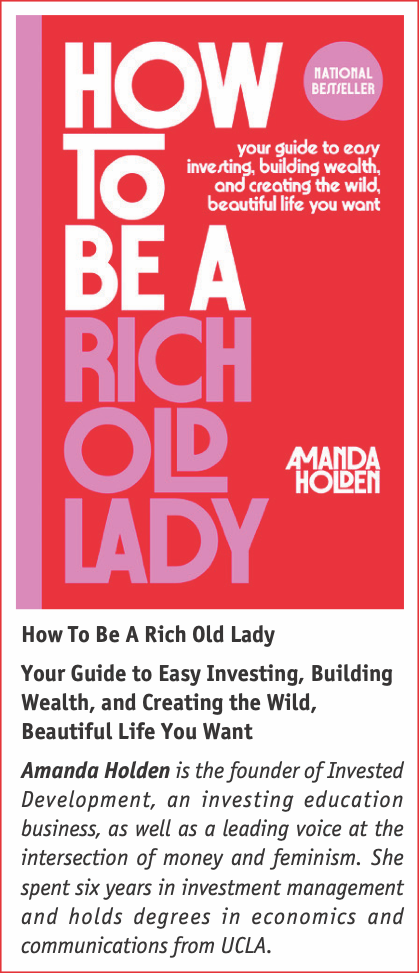
How To Be A Rich Old Lady
Are women richer than ever, or falling behind? The “Great Wealth Transfer” is expected to shift more than US $30 trillion in assets to U.S. women by the end of the decade, and up to $4 trillion to Canadian women by 2028.
So, yippee.
But poverty rates among women have started to rise again after a long period of decline, compounded by a perfect storm of higher inflation, lower wages compared to men, unpaid domestic labour, and systemic barriers to economic progress, such as poor access to reliable childcare, and a reduction in work-from-home employment opportunities.
Being a “bag lady” is a common fear among women, both rich and poor. But fear is not always the best motivator. Amanda Holden, a former investment analyst and a financial educator, has written her first book, How to be a Rich Old Lady, based on her coaching thousands of women to become more financially secure later in life.
Rita Silvan spoke to Amanda about how women can practice financial “self-care” and become Rich Old Ladies. Below is the edited version of the interview.
RS: What initially attracted you to become an investment analyst, and why did you quit?
AH: I had a degree in economics, and I thought this was what you’re supposed to do with it. I began working in 2008, and it was a very tense time. By 2010, I was in a client-facing role, meeting with high-net-worth clients, some of whose portfolios lost 50 per cent during the crash, so my job was to be screamed at by rich, white men. I was 25 years old and thought, “This cannot be my life”. A female co-worker encouraged me to leave and find something better to do.
RS: You’ve taught financial literacy to more than 25,000 women. What are some common issues you encounter?
AH: The hardest situation is a woman in her 50s, 60s, or 70s who is caught by a surprise divorce and has no idea what’s going on with the family money. She may not even know the passwords or how to log into their bank and investment accounts.
Another issue I see is a woman who is unaware of the terms of a prenuptial agreement or not having one in the first place, and being left without any sources of income. If a woman is losing current and future income by working at home and raising a family, that loss of income must be addressed contractually.
RS: Obviously, it’s best to start building wealth earlier in life to take advantage of compounding effects. Gen Z seem to spend what they earn and neglect saving and investing compared to previous generations.
AH: High living costs, the huge burden of student debt, along with geopolitical violence, are leaving Gen Z less hopeful about the future. I see young people who have a real distrust of the financial markets. They don’t invest because they are expecting some sort of collapse. They don’t buy real estate because they figure the bank is the real owner. Those beliefs contribute to YOLO [you only live once].
I say to them, “If your worst fear is having nothing, then by doing nothing, you’re guaranteeing that outcome. Instead, create a hedge by getting your finances together.” I suggest they start simply with a high-interest savings account. At some point, they’re going to need that $10,000 and be glad they have it.”
RS: Why do you say that women need an emergency cash fund even more than men?
AH: Every person needs one, but I have worked with enough women to know that in the event of a bad situation, like a bad boss or bad boyfriend or husband, a woman must have immediate access to financial resources that allow her to act from a place of power. Cash is central to that.
RS: In your book, you refer to the “work-consumption” loop that keeps people financially strapped, especially women. What is it and how can we manage it better?
AH: There’s some truth to the idea that to make money, you must spend money. The beauty standard is real. Studies show that people who are perceived as attractive earn more money, for example. When women wear make-up or style themselves in a certain way, it shows compliance and that they are willing to play the game.
Women just need to remember that spending excessively on cosmetics and apparel was not our idea to begin with. Can you imagine all the industries that would collapse if women liked themselves more? If the goal of wearing designer clothes and accessories is to be seen as successful and a route to earn more money, well, there’s a more direct way—save and invest.
RS: One entrenched narrative about women and investing is that women take fewer financial risks and that this can hurt our long-term financial stability. What’s your take?
AH: I think minority groups are more risk-aware because they need to be. They spend their entire lives analyzing every single risk that could come, so I would say, yes, women have a better sense of risk than men. This makes them less susceptible to trading and gambling addictions. However, the financial industry exploits those anxieties by marketing higher-cost products to women and minorities.
RS: Who’s a “rich old lady” you admire?
AH: Jane Fonda! But, really, “rich old lady” is simply an avatar for financial independence. She’s a regular woman who wants enough money to live a life of security and generosity. She uses money as a tool for community, not just consumption. “Rich old ladies” are living their lives to the fullest, and they’re everywhere.
RS: Can money buy happiness?
AH: Some amount of money is necessary to buy the conditions for happiness. Money can’t buy you out of every problem, but it is helpful.
Rita Silvan, CIM is a finance journalist specializing in women and investing. She is the former editor-in-chief of ELLE Canada and Golden Girl Finance. Rita produces content for leading financial institutions and wealth advisors and has appeared on BNN Bloomberg, CBC Newsworld, and other media outlets.
Amanda Holden is the founder of Invested Development, an investing education business, as well as a leading voice at the intersection of money and feminism. She spent six years in investment management and holds degrees in economics and communications from UCLA.