

Understanding The Business Cycle: Why Sectors Rotate
The economy moves through distinct stages, following a pattern of ebbs and flows. These phases are called the early-cycle, mid-cycle, late-cycle and recession. As the economy progresses through these stages, it impacts corporate earnings, interest rates, and inflation, among many other economic factors.
Each of these phases has its own unique characteristics and moves with a rhythm. This article is designed to help investors understand the tempo and profit from it.
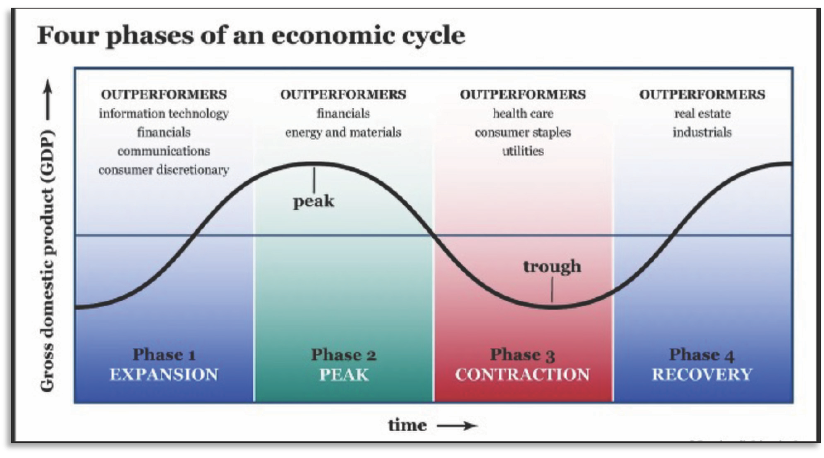
Early-Cycle (phase 1 expansion)
Following an economic downturn, the economy starts to rebound and stabilize. The recovery can be robust or gradual. Gross Domestic Product (GDP) and industrial output turn from negative to positive. Interest rates have bottomed. Central banks such as the U.S. Federal Open Market Committee (FOMC) or the Canadian Bank of Canada (BoC) remain accommodating. The U.S. dollar is at or near a low point. The Canadian dollar is normally elevated (sometimes at par with the U.S. dollar). Bond prices are elevated. Equity sectors, such as Technology and Consumer Discretionary, are the first to recover. The Real Estate and Industrial sectors often outperform in phase 1.
Mid-Cycle (phase 1 expansion)
This stage is usually the longest phase, for both the economy and the stock market. This section of the business cycle is said to be a bull market. Momentum continues to grow. Businesses gain profitability. Consumer confidence strengthens. Spending picks up. Unemployment begins to decline as companies' hiring increases. There are stable interest rates and inflationary pressure. Sectors that tend to perform better are Consumer Discretionary, Financials, Technology, Industrials, and Communication Services.
Late-Cycle (phase 2 peak)
Interest rates tend to begin rising as central banks try to “cool” the economy and extend the economic expansion. In this environment, sectors that are less sensitive to economic slowdowns perform relatively better, such as Energy, Financials and Materials (precious and industrial metals). Consumers begin to back away from non-essential spending, the Consumer Staples sector tends to hold up better than the Consumer Discretionary sector.
Recession (phase 3)
This phase is characterized by a slowdown in the economy. Interest rates are at a low level. Gross Domestic Product (GDP) is contracting, and businesses will reduce employees. There is demand for inventories. The news about the economy is generally negative, causing consumers to postpone big-ticket items. Earnings expectations drop, and stocks follow suit. Investors move to safe-haven defensive sectors, such as Healthcare, Utilities and Consumer Staples. The Technology sector is at a low. For some investors who are looking longer-term, this offers an opportunity.
Sector Rotation
Sector rotation is based on earnings growth or decline, interest rate fluctuations, U.S. dollar movement, and GDP expansion or contraction. Each of these factors affects industry groups differently. Some positively, some negatively. Many investors are also influenced by social media.
The goal is to increase portfolio returns by first determining which sectors are outperforming, and from there, which stage the business cycle is entering, or is currently in.
Final notes: From our analysis, the business cycle and the stock market are in Phase 2 (peak). The stock market is mature. Over the last 125 years, the average bull market has been 18 years in duration. The present bull market is 16-17 years old.
Donald W. Dony, FCSI, MFTA. Analyst, past instructor for the Canadian Securities Institute (CSI), editor for www.technicalspeculator.com.
Contact information: dwdony@shaw.ca