

Why ETFs Offer a Smarter Path Than Stock Picking
For decades, investors have debated whether it’s better to build a portfolio one stock at a time or to rely on diversified investment vehicles that capture broad market exposure. While stock picking can sound appealing, and even exciting, the data has increasingly shown that selecting individual winners is far more difficult than many realize. Exchange Traded Funds (ETFs), by contrast, have emerged as one of the most efficient, transparent, and investor friendly ways to gain market exposure.
The Challenge With Stock Picking
Market research consistently shows that most actively managed portfolios underperform their benchmarks over long periods. According to research by S&P Dow Jones Indices, over a 10 year investment period, only 14% of active stock pickers were able to outperform their benchmark of the S&P 500 Index. And the stock pickers assessed were professional portfolio managers, with institutional level research tools.1
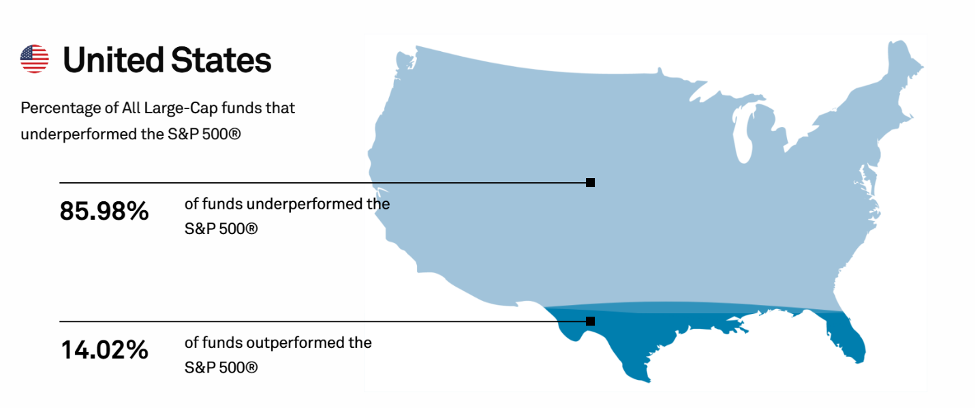
Research such as the SPIVA (S&P Indices Versus Active) reports consistently shows that most active managers fail to outperform their benchmarks over time. Across one-year, three-year, and five-year periods, a majority of actively managed funds lag their index counterparts after accounting for fees. This underperformance is even more pronounced in highly efficient equity markets like in the U.S., where information is abundant and price discovery occurs rapidly. 2
So why do active stock pickers have such a hard time beating the broad market? Much of this comes down to how markets behave. Equity markets are efficient, meaning new information is quickly reflected in stock prices, making it hard to consistently find mispriced securities. On top of that, stock returns are skewed: a small proportion of companies generate the majority of overall market gains. Missing even one or two of those winners can dramatically reduce returns.
Stock picking also introduces concentration risk. When investors place large bets on a few companies, especially ones in similar sectors, their portfolios become vulnerable to company-specific shocks, earnings misses, regulatory changes, or broader sector downturns. Managing that risk properly requires research, diversification, and ongoing monitoring, tasks that many investors lack the time, expertise, data, or discipline to perform consistently.
Index Investing And The Rise Of ETFs
This is where ETFs have transformed the investing landscape. Index based ETFs allow investors to buy all the stocks in a specific benchmark such as the S&P 500 Index, the NASDAQ 100 Index, or the TSX Composite Index with a single trade. Instead of trying to guess which companies will be tomorrow’s winners, ETF investors benefit from the market’s natural long-term growth.
The advantages associated with ETFs begin with diversification. By owning a basket of securities, one company’s weakness is offset by others’ strengths. This helps smooth returns and reduces the impact of market volatility. Market capitalization weighting, used by many major indices, ensures that the most influential companies contribute proportionally to performance, providing a balanced representation of the economy.
ETFs also solve a practical issue: efficiency. Building a diversified portfolio stock by stock requires hundreds or even thousands of trades. ETFs consolidate this into one simple transaction. Rebalancing, which maintains the appropriate weights of each security, keeps the initial risk profile of the portfolio in check and is handled automatically within the ETF structure, ensuring portfolios remain aligned with their target exposures.
Why ETFs Work Well In Investor Accounts
Beyond broad market exposure, ETFs offer a versatile toolkit for building an entire portfolio. Investors can use:
- Core index ETFs as long-term foundational holdings.
- Dividend or covered call ETFs to generate cash flow.
- Sector and thematic ETFs for tactical opportunities or market tilts.
- Fixed income ETFs to manage risk and stabilize returns.
- Asset allocation ETFs for all-in-one core portfolio holdings. in one
This range allows investors to access virtually any market, region, strategy, or asset class at low cost and with instant liquidity.
The Bottom Line
While stock picking will always appeal to investors who enjoy the challenge, the odds are stacked against consistently beating the market. ETFs, especially those that track a broad market index, offer diversification, transparency, operational efficiency, and low costs, all of which support more reliable outcomes. For investors seeking a disciplined, long-term investment approach, ETFs provide a smarter, simpler, and more strategic path to building wealth.
Danielle Neziol is Vice President, ETF Online Distribution at BMO ETFs, with over eight years of experience driving ETF product development and strategy through collaboration with exchanges, capital markets, index providers, and portfolio managers. She now focuses on delivering ETF insights and education to investors and industry professionals. Danielle is a frequent speaker and media contributor, appears on BNN, and hosts the weekly YouTube channel ETF Market Insights.
Sources:
1 https://www.spglobal.com/spdji/en/research-insights/spiva/ June 30 2025.
2 https://www.spglobal.com/spdji/en/research-insights/spiva/ June 30 2025.
Disclaimer:
The BMO ETFs sponsored articles are intended for information purposes only. They have been prepared by the respective authors and represent their assessment at the time of publication. The comments herein do not necessarily represent the views of BMO Global Asset Management. The views are subject to change without notice as markets change over time. The information contained herein does not constitute a solicitation of an offer to buy, or an offer to sell securities, and should not be construed as investment, tax or legal advice to any party. Particular investments and/or trading strategies should be evaluated and professional advice should be obtained with respect to any circumstance. Past performance is no guarantee of future results.
Any statement that necessarily depends on future events may be a forward-looking statement. Forward-looking statements are not guarantees of performance. They involve risks, uncertainties and assumptions. Although such statements are based on assumptions that are believed to be reasonable, there can be no assurance that actual results will not differ materially from expectations. Investors are cautioned not to rely unduly on any forward-looking statements. In connection with any forward-looking statements, investors should carefully consider the areas of risk described in the most recent simplified prospectus.
Commissions, management fees and expenses all may be associated with investments in exchange-traded funds. Please read the ETF Facts or prospectus of the BMO ETFs before investing. Exchange-traded funds are not guaranteed, their values change frequently and past performance may not be repeated. For a summary of the risks of an investment in the BMO ETFs, please see the specific risks set out in the prospectus. BMO ETFs trade like stocks, fluctuate in market value and may trade at a discount to their net asset value, which may increase the risk of loss. Distributions are not guaranteed and are subject to change and/or elimination.
"The Select Sector SPDRÆ Trust consists of eleven separate investment portfolios (each a “Select Sector SPDR® ETF” or an “ETF” and collectively the “Select Sector SPDR® ETFs” or the “ETFs”). Each Select Sector SPDRÆ ETF is an “index fund” that invests in a particular sector or group of industries represented by a specified Select Sector Index. The companies included in each Select Sector Index are selected on the basis of general industry classification from a universe of companies defined by the S&P 500Æ. The investment objective of each ETF is to provide investment results that, before expenses, correspond generally to the price and yield performance of publicly traded equity securities of companies in a particular sector or group of industries, as represented by a specified market sector index.
The S&P 500®, SPDRs®, and Select Sector SPDRs® are trademarks of The McGraw-Hill Companies, Inc. and have been licensed for use. The stocks included in each Select Sector Index were selected by the compilation agent. Their composition and weighting can be expected to differ to that in any similar indexes that are published by S&P.
The S&P 500 Index is an unmanaged index of 500 common stocks that is generally considered representative of the U.S. stock market. The index is heavily weighted toward stocks with large market capitalizations and represents approximately two-thirds of the total market value of all domestic common stocks. The S&P 500 Index figures do not reflect any fees, expenses or taxes. An investor should consider investment objectives, risks, fees and expenses before investing.
You cannot invest directly in an index.
An investment in Canadian depositary receipts (“CDRs”) issued by Bank of Montreal (“BMO”) may not be suitable for all investors. Important information about these investments is contained in the short form base shelf prospectus and prospectus supplement for each series of CDRs (together, the “Prospectus”). Purchasers are directed to www.sedarplus.ca or to bmogam.com to obtain copies of the Prospectus and related disclosure before purchasing CDRs. Each series of CDRs relates to a single class of equity securities (the “Underlying Shares”) of an issuer incorporated outside of Canada (the “Underlying Issuer”). For each series of CDRs, the Prospectus will provide additional information regarding such series, including information regarding the Underlying Issuer and Underlying Shares for such series. Neither BMO and its affiliates nor any other person involved in the distribution of CDRs accepts any responsibility for any disclosure provided by any Underlying Issuer (including information contained herein or in the Prospectus that has been extracted from any Underlying Issuer’s publicly disseminated disclosure). Each series of CDRs is only offered to investors in Canada in accordance with applicable laws and regulatory requirements.
Commissions, management fees and expenses all may be associated with investments in exchange-traded funds. Please read the ETF Facts or prospectus of the BMO ETFs before investing. The indicated rates of return are the historical annual compounded total returns including changes in unit value and reinvestment of all dividends or distributions and do not take into account sales, redemption, distribution or optional charges or income taxes payable by any unitholder that would have reduced returns. Exchange-traded funds are not guaranteed, their values change frequently and past performance may not be repeated.
BMO ETFs are managed by BMO Asset Management Inc., an investment fund manager, a portfolio manager, and a separate legal entity from Bank of Montreal. BMO Global Asset Management is a brand name under which BMO Asset Management Inc. and BMO Investments Inc. operate.
BMO (M bar roundel symbol) is a registered trademark of Bank of Montreal, used under licence.